About the Author: Michael
I am an independent automotive security specialist operating across Staten Island. Over the last decade, I have programmed keys for nearly every make and model on the road, utilizing dealership-level diagnostic software and advanced eprom programmers.
"I just need a spare key, how long will this take?" If I had a dollar for every time I heard this question in a Staten Island parking lot, I'd retire. The truth is, "programming a key" is a massive umbrella term that covers wildly different technical processes depending entirely on what vehicle you drive.
For a 2012 Honda Civic, I can cut and program a transponder key in under 10 minutes. For a 2019 BMW 5-Series that has lost all its keys, I might be parked in your driveway for three hours removing computer modules. Below, I break down exactly what dictates the timeframe, the underlying technology, and why dealerships take all day.
1. The Three Layers of Automotive Key Technology
To understand the time required, you must understand what is actually being programmed. A modern "car key" is actually three distinct security systems packed into one piece of plastic:
- The Mechanical Cut: The physical blade that turns the ignition cylinder. (Takes 2-5 minutes on an automated CNC key cutting machine).
- The Keyless Entry Remote: The circuit board that sends a radio frequency (usually 315MHz or 433MHz) to lock/unlock the doors. (Programming takes 1-3 minutes).
- The Immobilizer Transponder (RFID): The tiny glass or carbon chip inside the head of the key. If this chip is not mathematically synchronized with the car's Engine Control Unit (ECU), the car will crank but the fuel injectors will not fire. (Programming takes anywhere from 5 minutes to several hours).
2. The 5 to 15-Minute Category (Standard OBD-II Programming)
For about 70% of the cars on the road today (most domestic and Asian imports), programming is a streamlined process performed through the OBD-II diagnostic port under the steering wheel.
Makes: Ford, Chevrolet, Dodge, Honda, Nissan, Hyundai, Kia, Mazda.
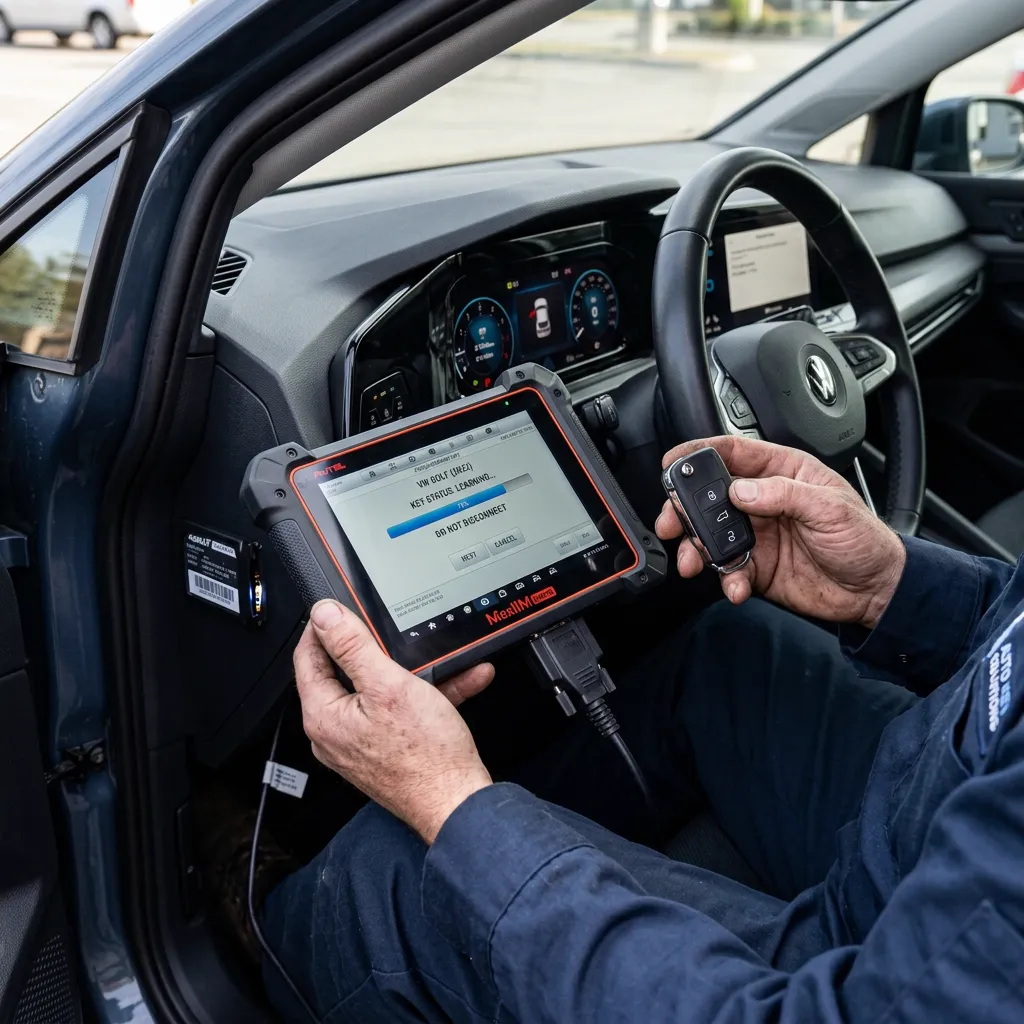
The Process: The locksmith plugs a specialized diagnostic tablet into the OBD-II port. The tablet establishes a handshake protocol with the vehicle's Immobilizer Control Module (ICM). We enter a security PIN code (either pulled directly from the car's memory or purchased from a secure dealer database), and instruct the car to "learn" the unique serial number of the new transponder chip.
Time Required: Once the tablet is connected, the actual digital transfer takes seconds. Certain manufacturers impose a mandatory security delay (Ford requires a 10-minute countdown timer to prevent rapid theft). Overall, expect the entire job, including cutting the physical blade, to take 15 to 20 minutes.
3. The 30 to 60-Minute Category (European and Advanced Systems)
European vehicles and high-end luxury models employ significantly more aggressive anti-theft protocols.
Makes: Volkswagen, Audi, Volvo, older BMWs, Land Rover, Jaguar.
The Process: These vehicles use "rolling codes" or pre-coded dealer keys. The locksmith's computer must read the encryption data directly from the car's dashboard cluster or Body Control Module (BCM), decrypt the data on a server, and then write a highly specific mathematical algorithm onto the blank transponder chip before it can even be introduced to the car.
Time Required: Decrypting the component security data can take 15 to 30 minutes just for the server calculation. Including physical key cutting, expect this to take 45 minutes to an hour.
4. The 2 to 4-Hour Nightmare: "All Keys Lost" EEPROM Jobs
If you have an existing working key, adding a spare is relatively fast. If you have lost *every single key*, the difficulty skyrockets, particularly for Toyota/Lexus (pre-2010 models) and modern European vehicles (BMW, Mercedes, Porsche).
The Process (EEPROM): When a 2004 Lexus RX330 loses all its keys, the engine computer permanently locks itself. It will not accept OBD-II communication. A locksmith must physically remove the Engine Control Module from behind the glovebox, open the metal casing, locate an 8-pin microchip on the motherboard (the EEPROM chip), attach micro-clamps to the legs of the chip, read the binary hexadecimal code into a laptop, rewrite the binary code to "virginize" the immobilizer block, resolder the connections, and reinstall the computer into the car. Only then can a new key be programmed.
Time Required: Disassembling the dashboard, performing micro-soldering, and reassembling the vehicle takes 2 to 4 hours of intense, high-liability labor.
5. Why Does the Dealership Take "All Day"?
If you call a dealership and ask for a key, they will often tell you to drop the car off and pick it up the next afternoon. Why does it take them 24 hours when I can do it in 20 minutes?
Dealerships operate on extreme bureaucracy. They do not cut keys on-site for many models; they order them pre-cut from a regional warehouse based on your VIN. When the key arrives, your car is placed in a queue behind brake jobs, transmission rebuilds, and oil changes. The actual programming by the technician takes 15 minutes, but the administrative workflow takes a day. Furthermore, if you lose all keys to an older Toyota, the dealer will refuse to do EEPROM work; they will mandate replacing the entire engine computer, turning a $300 locksmith job into a $1,500 dealership nightmare.
6. Cloning vs. On-Board Programming
You may see hardware stores offering key programming in 3 minutes. Be aware of the difference between "cloning" and "programming."
- Cloning (Hardware Stores): They read the RFID signal of your original key and copy that exact signature onto an emulator chip. The car thinks it's seeing the original key. It is fast, but if you lose the original key later, the clone might fail depending on rolling code algorithms.
- On-Board Programming (Locksmiths): We log into the car's computer and add a completely new, unique key ID to the car's authorized list. If you lose a key, we can simultaneously delete the lost key's ID from the computer so it can no longer start the car.
A Crucial Tip for Staten Island Drivers
Never wait until you lose your only key. The cost and time required to program a *spare* key (15 minutes, standard OBD-II) is exponentially lower than the cost of an "All Keys Lost" situation, which often requires generating mechanical cuts from the door lock cylinder and bypassing aggressive security lockouts.
Ultimately, mobile automotive locksmiths are the most efficient route. We carry the CNC cutting machines, the diagnostic tablets, and the blank key inventory directly in our vans, allowing us to arrive at your location in Staten Island and generate a fully functional dealer-equivalent key on the spot. For a complete breakdown of what each key type costs across the five boroughs, see our detailed guide on our Staten Island car key replacement cost guide.