About the Author: Michael
I spend my days (and nights) rescuing stranded drivers across Staten Island. From keys locked in trunks at the Staten Island Mall to running engines in residential driveways, I utilize zero-damage entry techniques on everything from standard Fords to high-security Mercedes.
The image of a mechanic sliding a metal "Slim Jim" down the window glass to magically pop a lock is a relic of the 1990s. If you try that on a modern vehicle, you are going to sever an internal wiring harness and deploy your side-impact airbag.
Automotive security has evolved tremendously. Consequently, the tools and techniques required to bypass that security without causing structural or electrical damage have also evolved. Here is exactly what happens when you call a professional to unlock your car.
1. The Death of the Slim Jim
In older cars, the lock button on the door panel was connected to the actual latch mechanism by a simple vertical metal rod. A Slim Jim simply hooked that rod and pulled it up.
Today, doors are packed with electronics: window regulators, speaker wiring, power mirror cables, and explosive side-curtain airbag sensors. Furthermore, manufacturers now use shielded cables or heavy plastic boxes to encase the latch mechanisms, completely blocking any tool inserted down the window cavity. Shoving a coat hanger down there is a guaranteed way to cause $500 to $1,500 in electrical damage.
2. The Modern Standard: The Air Wedge and Long Reach Tool
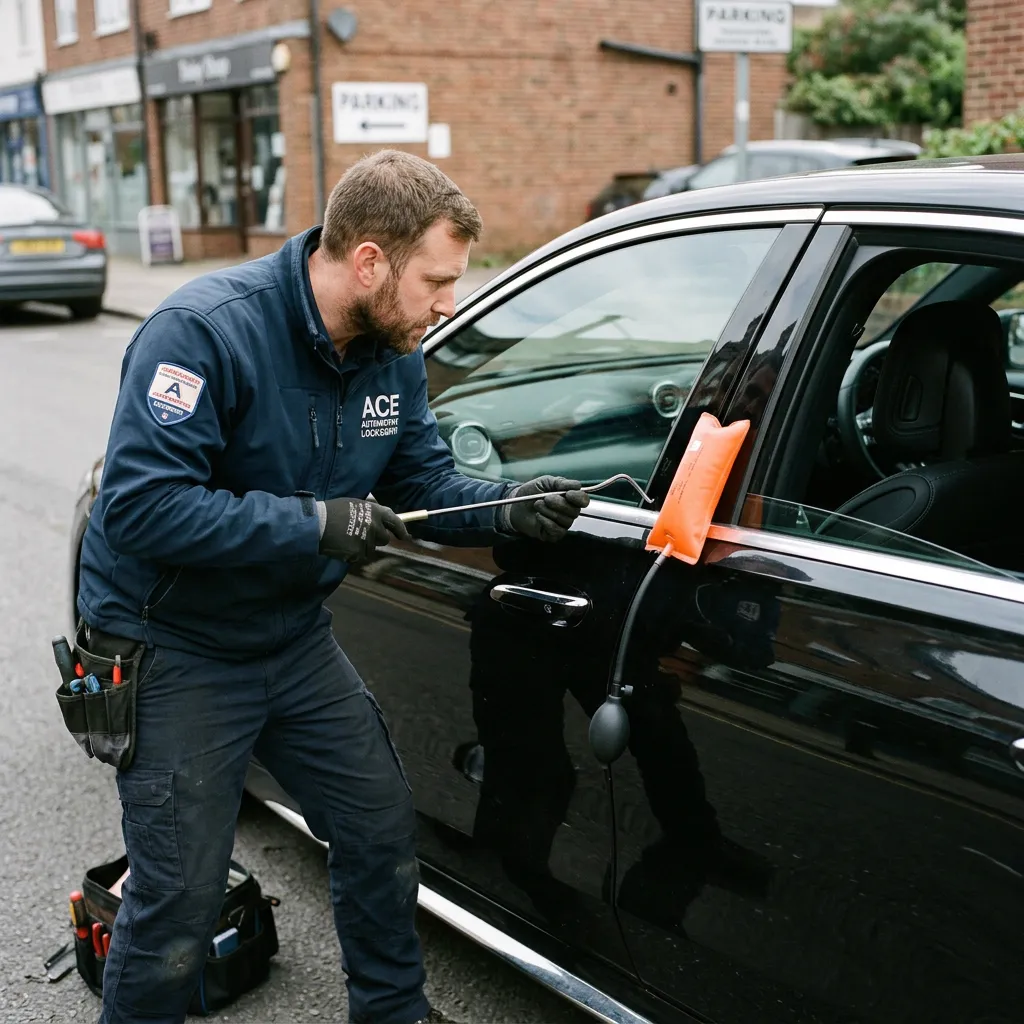
The primary method used by certified professionals on 80% of domestic and Asian vehicles involves the door frame, not the window glass.
The Technique: A highly durable, non-marring plastic wedge is gently tapped into the top corner of the door frame to create a tiny gap. A deflated Kevlar air wedge (which looks like a blood pressure cuff) is inserted into that gap. We pump the wedge, applying distributed, gentle pneumatic pressure to flex the door frame outward by exactly one-quarter of an inch.
Once the gap is created, a rubber-coated long reach tool is inserted into the cabin. We use this tool to manually press the electronic unlock button on the armrest, or hook and pull the interior door handle. Once the door opens, the air wedge is deflated, and the door frame immediately springs back to its original shape with zero structural damage and no scratched paint.
3. The European Nightmare: Deadlocked Vehicles
If you lock your keys inside a BMW, Volkswagen, Audi, or Volvo, the air wedge technique will fail completely. Why? Because of a security feature called "Deadlocking."
When you lock a European car with the fob, it disconnects the interior door handles and disables the electronic unlock buttons. If a thief breaks the window, they still cannot open the door from the inside.
The Solution: Lishi Picking. To unlock a deadlocked car, a professional locksmith cannot bypass the system; we must defeat the actual lock cylinder on the exterior of the door. We use highly specialized, optical-grade tools called Lishi decoders. The tool is inserted directly into the keyhole, and the locksmith meticulously feels and manipulates the individual microscopic metal wafers inside the lock until it mimics the physical presence of the key, rotating the cylinder and disarming the deadlock. This requires immense skill and specialized training.
4. Trunk Lockouts: Why It's Not Always Simple
Locking your keys in the trunk while loading groceries is incredibly common. You might assume the locksmith will just open the driver's door and pull the trunk release lever. Often, this doesn't work.
Many modern vehicles (especially Honda, Toyota, and luxury sedans) engage an anti-theft protocol when the car is locked. If the driver's door is opened mechanically without the key or fob present, the car's computer electronically disables the trunk release button to protect valuables in the trunk.
In these scenarios, the locksmith must either fold down the rear seats (if accessible from the cabin), or pick the physical lock cylinder located on the trunk lid itself. If neither is an option, we must use a CNC machine to cut a temporary mechanical key on the spot, just to put it into the ignition and turn the car's electronics "On" so the trunk button regains power.
Beware the Scam Dispatchers
If you are locked out in Staten Island and you search for a locksmith, beware of companies quoting "Only $15 or $25" over the phone. These are illegal bait-and-switch lead generation centers. They will dispatch an untrained subcontractor who will show up, demand $200+, and often damage your vehicle because they lack the proper pneumatic tools and Lishi picks. Always ask for a firm, flat-rate quote before the technician is dispatched.
A professional automotive lockout takes less than 10 minutes and leaves your vehicle in pristine condition. If you find yourself staring at your keys through the glass, step away from the coat hanger, do not throw a rock, and call a certified, local automotive locksmith. For a comprehensive guide on finding a car lockout locksmith near you in Staten Island, including what to do immediately and how to avoid scams, read our detailed article.
📖 Related: What to Do When Locked Out of Your Car
Our complete car lockout locksmith near me guide covers immediate steps, cost expectations, and how to choose the right professional for your vehicle type.